Kitchen Tools
Jubako: The Japanese New Year Box Nobody Bothers to Explain
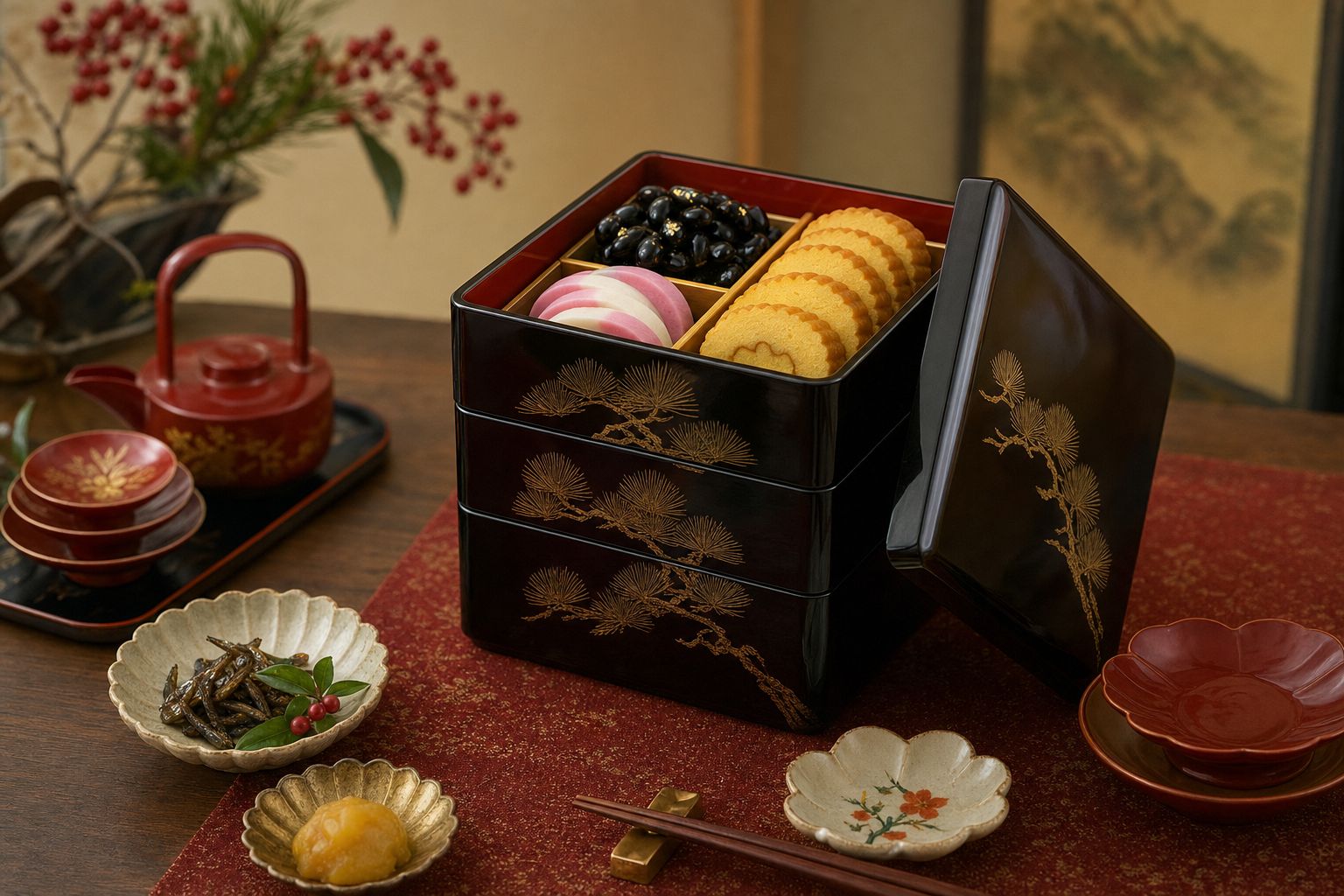
Every December, the same photo shows up on food blogs and Pinterest boards: a glossy black-and-red box, lid off, packed with tiny compartments of beans, rolled omelette and pink-and-white fish cake. Almost every caption talks about the food. Almost none of them explain the box.
The short answer: that box is a jubako (重箱) — a stacking lacquer box, traditionally three or five tiers, built specifically to hold osechi ryori, the New Year’s food Japanese households prepare before December 31 and eat cold for the first few days of January. The tiers have names instead of numbers, the count is almost always odd, and what you’ll actually find for sale ranges from a $20 plastic stand-in to a lacquer heirloom that costs more than the knife set in your kitchen. Below is what the box is actually doing, and whether a Western kitchen with limited shelf space has any real reason to own one.
Stacking it up, literally
Ju (重) means to pile up or layer; bako is just the word for box, softened here from hako. Put together, a jubako is nothing more exotic than “stacking box” — the same idea as a bento, just scaled up and, usually, a lot more formal.
The stacking isn’t only a space-saving trick, though it is also that. In Japan, piling the tiers is read as a wish: that good fortune keeps piling up, year after year, the same way the boxes do. It’s a small piece of wordplay dressed up as furniture, and it’s the kind of detail that gets left out of most English coverage of “what’s in an osechi box,” because the food is more photogenic than the logic behind the container it’s sitting in.
Boxes with names instead of numbers
Count the tiers from the top down and each one has a name, not a number: ichi-no-ju (first), ni-no-ju (second), san-no-ju (third). Three is the most common count in an ordinary household today, even though five tiers was the standard a few generations back — fewer people cook a five-tier spread from scratch, and odd numbers are considered lucky in Japan, so trimming down to three rather than four keeps the superstition intact.
If a fourth tier does show up, most guides are careful to avoid calling it the “fourth” box outright. The word for four, shi, is a near-homophone of the word for death, so hosts sidestep it with a different word for the same tier. Sources don’t fully agree on which replacement word wins out in everyday speech — some say yo, others write yon-no-ju — which tells you this is a live, slightly inconsistent custom rather than a fixed rule with one correct answer. Either way, nobody’s box is labeled “shi.”
A fifth tier, on the rare households that still use one, is sometimes left deliberately empty. Not as an oversight — as a placeholder for future luck, a box with nothing in it because there’s supposed to be room left for whatever good fortune the new year still has to add.
What’s actually inside, roughly
Ask five sources what goes in which tier and you’ll get five slightly different answers, and that’s honest — the contents shift by region and by family, the same way nobody’s grandmother’s stuffing recipe matches the one next door. The rough consensus runs something like this: the top tier usually holds small, celebratory bites meant to go with a drink — sweet black beans, herring roe, candied chestnut. The next tier down tends to carry grilled and vinegared seafood. Lower tiers usually get simmered vegetable dishes, the kind that hold up fine at room temperature for days, which is the whole point.
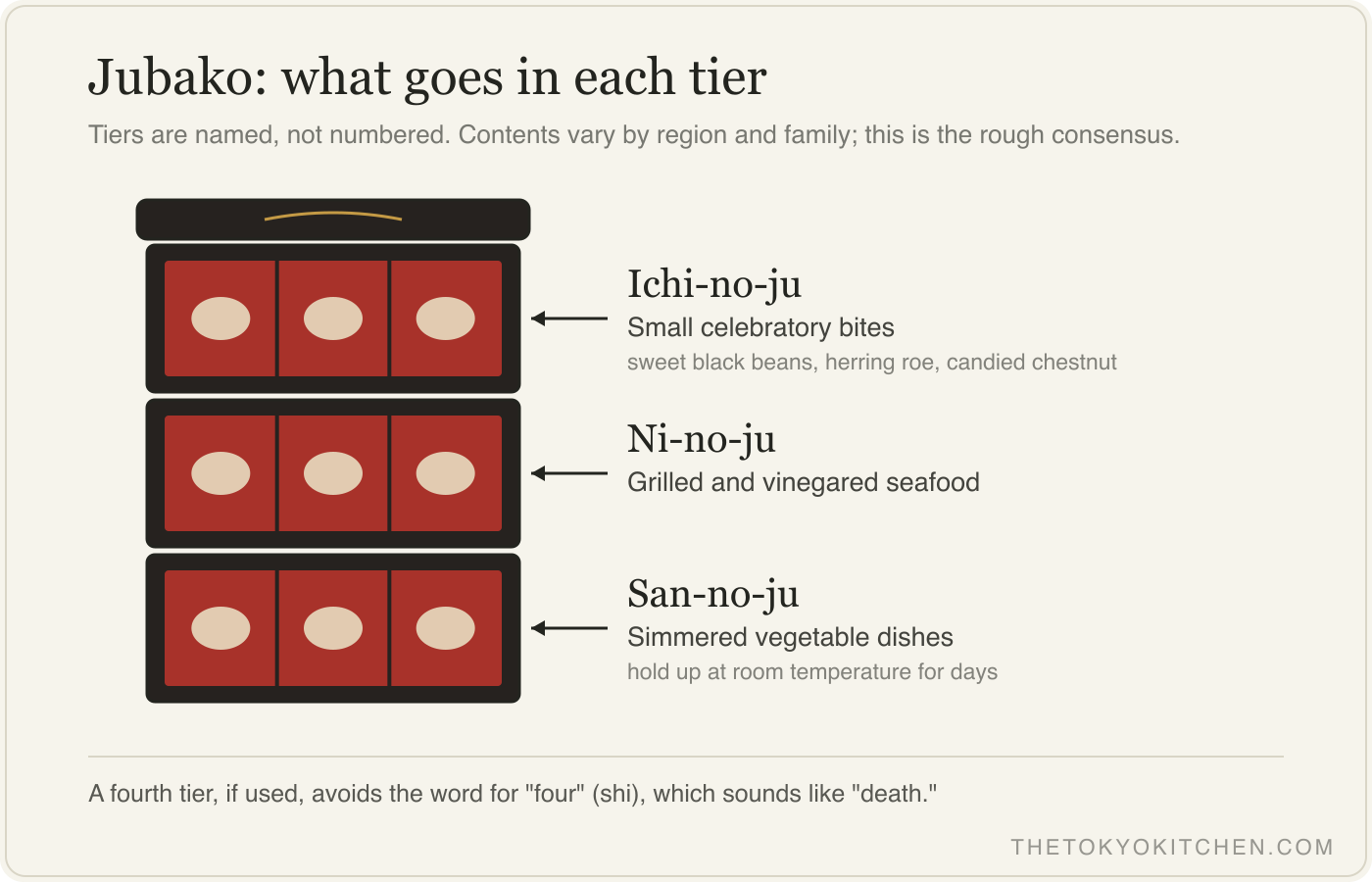
That room-temperature point matters more than it sounds. Osechi exists partly because tradition discouraged cooking over the first days of the new year — giving the kitchen, and whoever usually runs it, an actual rest. Every dish in the box is salty, sweet, vinegared or simmered specifically so it survives a few unrefrigerated days without anyone touching a stove. The same preference for simmered, slow-cooked dishes shows up in plenty of everyday Japanese cooking that has nothing to do with New Year at all — it’s just a kitchen culture that’s comfortable with food sitting and developing flavor rather than being eaten the second it’s off the heat.
The lacquer box versus the one you’ll actually buy
A real jubako is lacquerware — urushi, the same tree-sap finish used on traditional bowls and trays, sometimes decorated with gold-dust maki-e designs, built to be handed down rather than replaced.
Those pieces are genuinely expensive. A traditional lacquer box sold as an heirloom piece can run well into the hundreds of dollars, and a family’s “good” jubako is often older than everyone currently eating out of it.
Here’s the part nobody mentions on the product photo: most jubako sold today, including plenty labeled as lacquerware, are resin or plastic with a glossy coating designed to look like urushi. Honestly, that’s not a scam so much as the sensible modern answer — an everyday resin set is priced like ordinary kitchenware rather than an heirloom, and it does the job the box is actually hired for: holding food, stacking neatly, looking good on the table for one afternoon. It won’t ask anyone to hand-wash it the morning after a family gathering, either — some resin versions are genuinely dishwasher-safe, which no real urushi lacquer piece will ever forgive you for trying.
Buying the box without the food
There are two completely different purchases hiding under “buying osechi,” and mixing them up is an easy way to end up with the wrong thing. One is an empty jubako — just the stacking box, sold on its own at Japanese retailers and general marketplaces, meant for someone who wants to fill it themselves. The other is a pre-packed osechi set: department stores, hotels and specialty shops sell these already filled, for pickup or delivery right around New Year, and they’re priced as a whole meal rather than as cookware — a modest set might run the equivalent of a nice restaurant dinner, while a hotel’s flagship box can cost as much as a weekend trip.
Preorder windows for the filled sets open months ahead, and popular department-store and hotel sets can sell out by late November for delivery around December 30 — which means by the time most Western readers are thinking about osechi as a curiosity, the actual Japanese shopping season for it is already closing out. If what you actually want is the box — to use for bento, for a holiday cheese spread, for anything that benefits from separated compartments and a lid — buying an empty jubako on its own, any time of year, is the simpler and cheaper route in.
Where I land on this
I’ll say the honest thing a food blog selling the fantasy won’t: a jubako is a once-a-year object in most households, and once-a-year objects are exactly what a small kitchen can’t justify stacking shelf space for just because a photo looked good. If you already host a New Year’s meal, or you want one serving dish that makes a holiday spread look intentional instead of just plated onto whatever bowls were clean, a resin three-tier set earns its cupboard space. If you’re buying one purely because the Pinterest photo looked beautiful, you’ll likely use it twice and then store it the other 363 days of the year the same way a donabe clay pot sits waiting for the next cold night — which is fine, as long as you know that’s the deal going in.
What it isn’t is a replacement for the food. The box holds the meal together, literally and symbolically, but a square tamagoyaki pan is still doing the actual cooking for at least one of the dishes that ends up inside it. Buy the box for what it’s honestly for — a handsome, stackable way to serve food that’s designed to sit out for days — and don’t expect the lacquer, real or resin, to do any more than that.
Quick recap: a jubako is a stacking box, not a single dish; the tiers carry names rather than numbers and almost always add up odd; and the resin version most people actually buy is a reasonable stand-in for the lacquer heirloom rather than an apology for it.
If this is the first you’re hearing of jubako and you’ve still got time before the season’s preorder windows close, decide now whether you’re shopping for the box or the meal — they’re sold on two different calendars.
Here’s a word that’s handy to know once you’ve read this far: when someone thanks a host in Japan for a meal, the stock reply is a quick “Osomatsu!” — literally “it was a poor/clumsy thing,” used self-deprecatingly to mean “it was nothing.”
Osomatsu! (It was nothing.)
— Sen
Want the short version?
The One-Knife Kitchen: how to choose and care for the single Japanese knife that replaces the block — free, printable, one page.
Get the free guide →