Knives
Petty Knife, Explained: Japan's Small Utility Blade Nobody Buys on Purpose
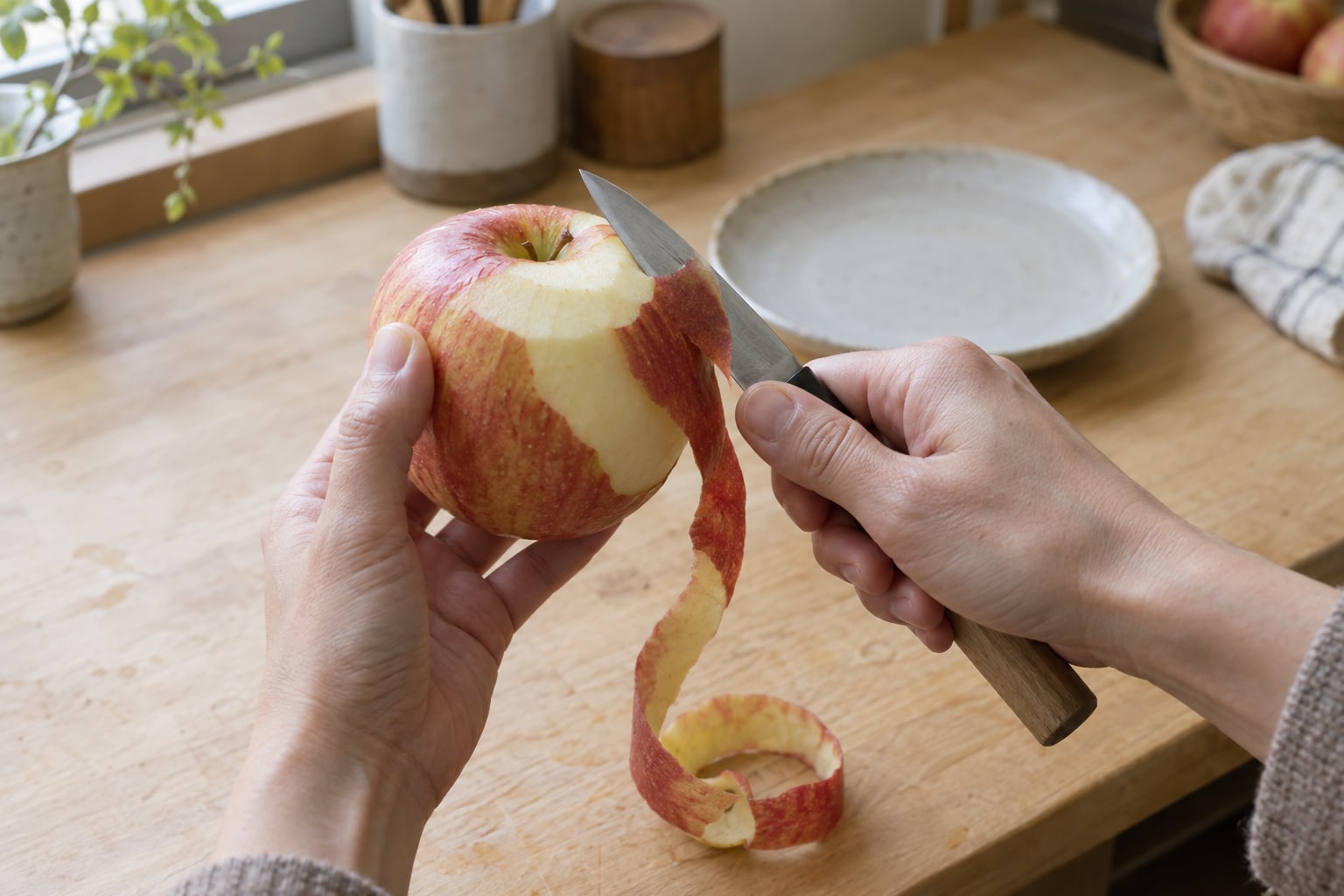
Ask someone what their second knife is, and most people can’t answer. Not because they don’t own one — because nobody sat down and chose it. My advice on a first Japanese knife ends with “buy one, learn it, stop shopping,” and I stand by that. But almost every kitchen, mine included, has a second blade anyway — smaller and usually cheaper, and it was never really the subject of its own buying decision. In Japan that knife has a name — petty knife — and it’s worth understanding on its own terms instead of as an afterthought.
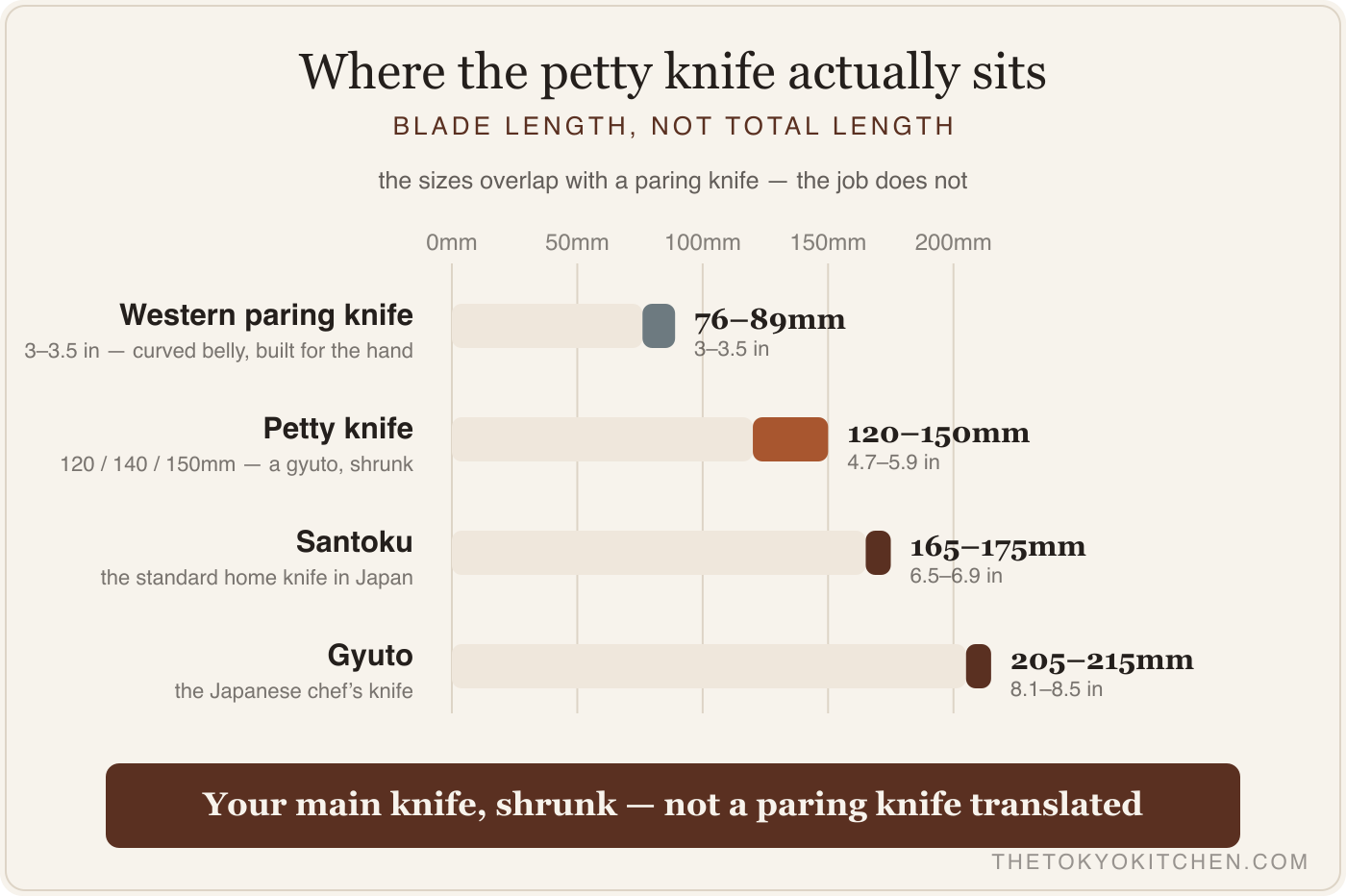
The short version: a petty knife is a small, double-bevel utility blade, usually 120–150mm, built like a miniature gyuto rather than a dedicated peeler. It handles fruit, garnish, small trimming, and anything too fiddly for a full-size knife. It is not a paring knife with a Japanese label on it, and it is not a knife you need to research the way you’d research your santoku. Most people end up with one before they’ve thought about it at all.
What “petty” actually means
The word is a loanword — from French petit, small — that came into Japanese kitchen vocabulary as petinaifu and got shortened. It has nothing to do with the English “petty,” meaning trivial, though the knife’s reputation suffers a little from the coincidence. A petty knife is the small end of the same design family as a gyuto: a Western-style, double-bevel blade with a point, just scaled down. That matters more than it sounds like it should, because it’s the reason a petty knife feels familiar in the hand the first time you pick one up. It’s not a specialist tool with its own technique to learn. It’s your chef’s knife, shrunk.
Common lengths run 120mm, 140mm, and 150mm. As a rough guide: 120mm is nimble enough for peeling and small garnish work, 150mm gives you enough blade to break down a chicken breast or slice a lemon into rounds without feeling cramped. There’s no wrong size, only a size that matches what you actually do with it — which, for most people, is smaller and lighter work than their main knife.
Petty knife vs. paring knife: not the same tool
It’s tempting to call a petty knife “the Japanese paring knife” and move on, but the two aren’t really interchangeable. A Western paring knife typically runs 2.5 to 4 inches (63–100mm), with 3 to 3.5 inches being the most common size — short, often with a curved belly built for turning an apple in your palm. A petty knife runs longer, straighter, and thinner, closer in profile to a scaled-down chef’s knife than to a peeler. You can peel an apple with either. You can also slice a shallot or trim silver skin off a chicken thigh with a petty knife in a way that a stubby 3-inch paring blade fights you on.
So: petty knife, not paring knife. That’s the one place in this article I’ll lean on that construction, because it’s the actual point — the size overlaps, the job doesn’t fully.
Why nobody buys it on purpose
The nakiri is a deliberate second-knife purchase — you notice you’re cutting a lot of cabbage, you go looking for a flat-edged vegetable knife, you buy one with intent. The petty knife almost never arrives that way. It shows up bundled into a starter set with a santoku, gets handed down from someone’s old kitchen, or gets picked up cheap at a home center because the drawer needed something smaller than the main knife. Ask a home cook in Japan why they own the specific petty knife they own, and the honest answer is usually a shrug.
That’s not a criticism of the knife. It’s just a different relationship than the one you build with a knife you researched for two weeks before buying. And it explains why petty knives get so little attention online compared to santoku and gyuto guides — nobody agonizes over the purchase, so nobody writes the agonizing comparison post afterward. This one’s an exception.
What I actually saw it do
At my wife’s family home in Tango, on the quieter, less-touristed coastal side of Kyoto prefecture, dinner ends the same way most winters: her mother goes to a drawer, not the block where the family’s santoku lives, and comes back with a small, worn knife I’ve never seen used for anything else. She peels a pear in one continuous strip, the skin falling into a single curl on the plate, and it’s done before the tea’s finished steeping. It’s the only time that particular knife comes out. The santoku handles dinner; this one handles dessert, and only dessert.
That’s a petty knife’s whole personality in one scene: a narrow job, handled with no ceremony at all — and somehow always sharp enough for it, even though nobody’s mentioned sharpening it in years.
What it’s good at, and what it isn’t
Peeling, trimming fat or silver skin, cutting citrus into rounds, deveining a shrimp, breaking down a single chicken breast, slicing a small onion when you don’t want to drag out the big knife for one ingredient — a petty knife handles all of it comfortably. It’s also genuinely pleasant for anything that happens in your hand rather than on the board, since the shorter blade gives you more control close to your fingers.
What it can’t do is anything close to volume. Don’t reach for a 120mm petty knife to break down a whole cabbage or a rack of ribs; that’s what your santoku or a nakiri is for, and a petty blade will just make the job slower and more tiring on your wrist. Treat it as a scaled-down version of your main knife and it disappoints you at exactly the moment you need volume, even though it’s built on the same basic shape.
Steel and sharpening: the same rules as your main knife
Because it’s a double-bevel Western-style grind, a petty knife sharpens exactly like the santoku or gyuto you already own — same stone, same angle, no separate technique to learn. The steel choice question is the same one too, and the full breakdown is here: stainless like VG-10 if you want to leave it on the drainer without thinking about it, carbon if you don’t mind the wipe-dry habit and want the sharper edge.
Masamoto’s VG line — a hyper carbon molybdenum-vanadium stainless with a POM resin handle, built for rust resistance rather than for the hardness numbers in that steel guide (the maker doesn’t publish an HRC figure for it) — is a sensible stainless option if you’re buying a petty knife as an actual decision rather than inheriting one. Hocho Knife lists the 150mm version (VG6315, 110g, 260mm overall) at $186.99, discounted to $162.99 when I checked. It ships from Japan, so if you’re already ordering a stone or a main knife from a Japanese specialist, it’s worth adding to the same box rather than paying international shipping twice. I haven’t used this specific model myself — the one I trust is the unnamed one that lives in a drawer in Tango — so treat this as steel and spec passed along, rather than a personal review.
The trade-off worth knowing before you click through: Masamoto doesn’t publish a hardness figure for the VG line the way the boutique makers in that steel guide do, so you’re buying a known name and a rust-resistant stainless rather than a spec sheet you can compare. For a knife that peels fruit, that’s a reasonable trade — but don’t expect it to out-hold an edge against a hard VG-10 gyuto just because it costs as much. See the petty knife section at Hocho Knife →
The honest recommendation
If you already have a santoku or gyuto and a drawer with a random small knife in it, you probably don’t need to buy anything. Use what’s there until it genuinely frustrates you — most petty knives, however they arrived, are perfectly capable of the small jobs they’re asked to do. Where I’d actually spend money is if your only “small knife” right now is a dull steak knife or a novelty paring knife from a gift set; in that case, a basic stainless petty from a mainstream Japanese maker — Kai’s Seki Magoroku line is the same home-center tier as the ¥3,000 santoku I’ve mentioned before, and a fraction of what the Masamoto costs — does the job without ceremony, and you can skip the $160 one entirely until you’ve decided you care.
What you shouldn’t do is treat a petty knife as your only knife. It’s too small for real prep volume, and buying a beautiful one before you own a proper santoku or gyuto is spending your first knife budget on your second knife’s job.
It’s the blade that does the unglamorous 5% of the meal — the peel, the trim, the last citrus wedge — reliably enough that nobody thinks to mention it. That’s not a small compliment for a knife this size.
If you’re still deciding what to buy first, The One-Knife Kitchen covers that — one page, no petty knife required yet.
— Sen
Want the short version?
The One-Knife Kitchen: how to choose and care for the single Japanese knife that replaces the block — free, printable, one page.
Send me the free guide →