Kitchen Tools
How Japan Really Cleans Cutting Boards (Not the Viral Myth)
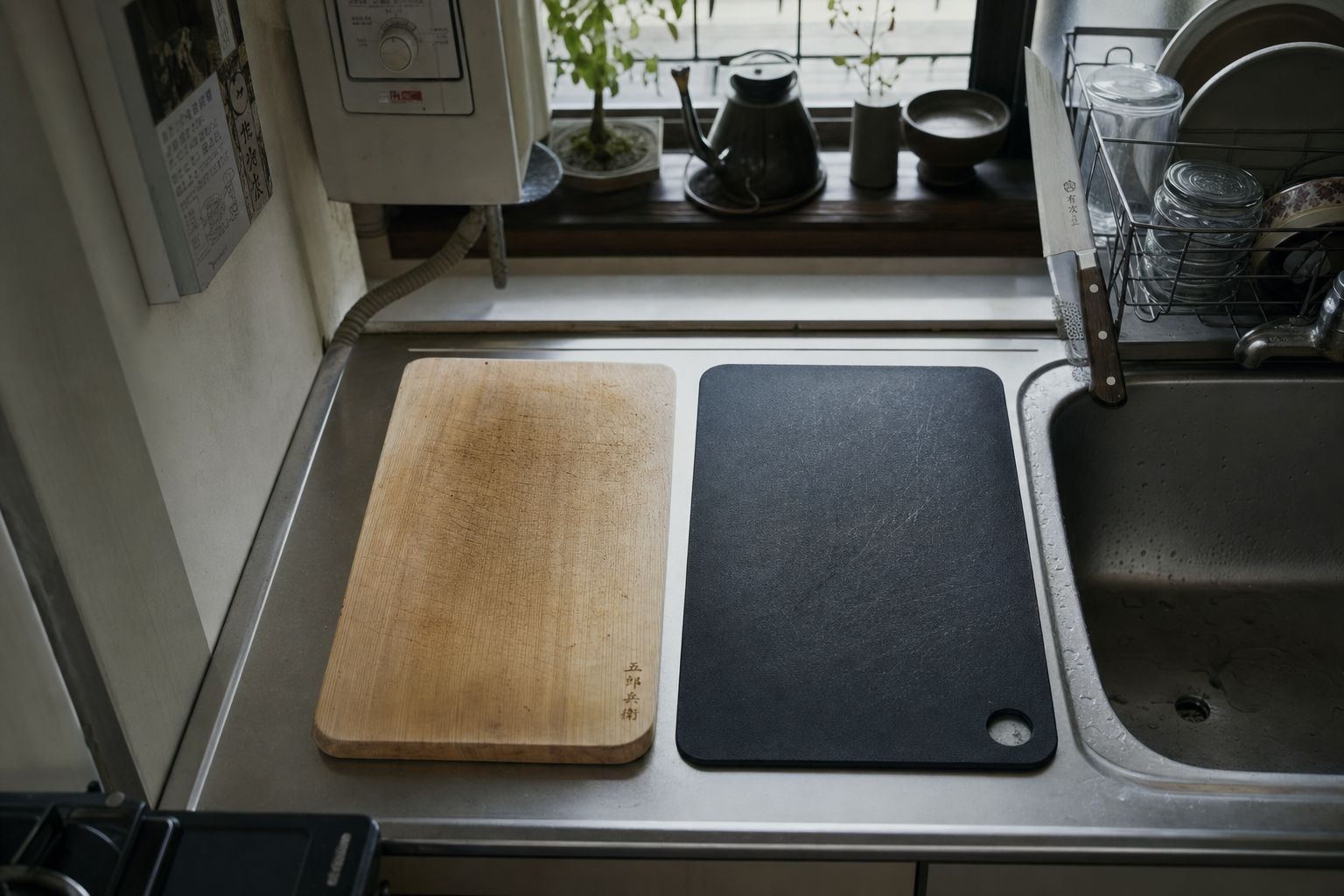
Japan cleans cutting boards the same way food-safety agencies everywhere recommend: wash with dish detergent right after use, then disinfect with boiling water or diluted chlorine kitchen bleach, and let it dry fully. Japan’s health ministry also recommends separate boards — or at least washing between uses — for raw meat or fish and food you eat raw. The myth that Japanese kitchens “just rinse” a board isn’t in any of that guidance.
The short answer on which board: choose by three things — how kind it is to your knife, how you’ll wash it, and where it will dry. Wood (hinoki) is light and kind to edges but must be hand-washed and dried standing. Rubber or elastomer is softest on edges and heavy; one popular model must not go in a dishwasher, another can. Polyethylene (PE) is the easiest to sanitize and replace. Glass and stone are the ones to skip: they dull an edge fast.
The cost of choosing wrong is real: a board that doesn’t fit your sink never gets washed properly, a board dried flat warps or stays damp, and a rubber board in the dishwasher can deform. Below: how Japan cleans boards, six models across the three materials with what the makers say about care, how to measure your space, and where to dry the board.
How Japan cleans a cutting board
Japan’s Ministry of Health, Labour and Welfare, the government’s public-relations office and the farm ministry all give the same routine for home kitchens:
- Wash right after use with dish detergent and running water, scrubbing along the knife grooves.
- Disinfect: pour boiling water over it, or use diluted chlorine kitchen bleach (sodium hypochlorite) as the label directs. The health ministry also mentions an overnight soak in bleach solution — but check your board’s own instructions first, because some makers limit soaking (below).
- Dry it in a clean, ventilated spot.
- Separate raw meat and fish. Don’t cut raw-eaten or cooked food on a board that just had raw meat until it’s been washed and disinfected. Separate boards for meat, fish and vegetables are safer still.
The U.S. Department of Agriculture says much the same: hot soapy water after each use, sanitize with 1 tablespoon of unscented chlorine bleach per gallon of water, and replace boards with deep, hard-to-clean grooves.
So the real Japanese difference isn’t the washing. It’s the board itself, and the small space it has to fit.
Three materials, six models
Specs and care rules from the makers’ own pages and manuals; prices and sellers checked November 8, 2026. These are research-based comparisons, not boards tested in my kitchen.
| Model | Surface / core | Size (cm / in) | Weight | Dishwasher | Heat limit | Bleach | Price, seller (Nov 8, 2026) | Downside |
|---|---|---|---|---|---|---|---|---|
| Kai hinoki board AP5228 (wood) | Solid Japanese hinoki | 36 × 24 × 1.2 cm / 14.2 × 9.4 × 0.47 in | about 460 g / 1.0 lb | No (no dish dryer either); no soaking | Keep hot pots off it | Not stated; ethanol is OK | ¥3,850, Kai’s own store (ships within Japan only) | Hand-wash only; stains; can warp if dried flat |
| Hinoki board, size M (wood, sold by Hocho Knife) | Hinoki, mold-proof coating on the end grain | 30 × 19 × 2 cm / 11.8 × 7.5 × 0.8 in | about 470 g | Not stated | Not stated | Not stated | $85.99 (sale), Hocho Knife, ships from Japan | Maker not named; no care rules on the page |
| Asahi Cookin’ Cut HOME, M (rubber) | Synthetic rubber; antibacterial (SIAA) on the HOME line | 38 × 21 × 1.3 cm / 15.0 × 8.3 × 0.5 in | 1.1 kg / 2.4 lb | No — heat softens it and it can warp | 100°C; hot-water rinse at 90°C or below, both sides | Chlorine kitchen bleach OK; no long soaks | $79.90, Amazon US (third-party seller) | Heavy; warps if leaned at an angle or used on one side only |
| Hasegawa FSR20-6030 (elastomer) | Elastomer surface (5 mm a side) over a sealed wood core | 60 × 30 × 2 cm / 23.6 × 11.8 × 0.8 in | 2.4 kg / 5.3 lb | Yes | Sterilizer cabinet 80–85°C; no boiling, no UV cabinet | Chlorine 200–400 ppm, 5 min or less, rinse well | $164, MTC Kitchen (U.S.) | Professional sizes only; expensive; Hasegawa says it doesn’t supply Amazon sellers |
| Tenryo peelable board (PE) | Polyethylene; two 5 mm peel-off layers on a 10 mm base | 50 × 24 × 2 cm / 19.7 × 9.4 × 0.8 in | 2.4 kg / 5.3 lb | Not stated | 90°C; boiling water and sterilizers can warp it | OK for stubborn stains; rinse well | $60.99, Hocho Knife (affiliate link), ships from Japan | Heavy for its size; turn it over daily to stop warping |
| Hasegawa PE Karugaru SD20-4123 (PE) | Polyethylene (5 mm a side) over a wood core | 41 × 23 × 2 cm / 16.1 × 9.1 × 0.8 in | 1.3 kg / 2.9 lb | Yes | Boiling 5 min or less OK; sterilizer cabinet 90°C | Chlorine 200–400 ppm, 5 min or less | ¥13,200 before tax, Japanese list price; U.S. stockist not confirmed | Harder surface than soft rubber, so less gentle on an edge |
Three things in that table surprise people:
- “Rubber” doesn’t mean one care routine. Asahi Cookin’ Cut must not go in a dishwasher; Hasegawa’s elastomer board can, but must never be boiled. Read your own board’s manual, not a general rule.
- “Antibacterial” doesn’t mean “rinse and done.” Parker Asahi, the maker of Cookin’ Cut, warns in its own catalog that bacteria can still grow if food residue is left on the board, antibacterial agent or not. Wash it every time.
- Hinoki boards differ too. Kai tells you not to put its hinoki boards in a dishwasher or dish dryer. A dishwasher-safe claim on a marketplace listing isn’t the maker’s word.
What the makers say about warping is consistent: heat and uneven drying cause it. That shapes where you’ll keep the board, which comes next.
Measure before you buy
Board length matters less than whether it fits the three places it has to go: the counter, the sink and the drying spot. You don’t need a special tool, just a tape measure.
- Counter strip: measure the depth and width of the space where you’ll cut. Leave at least a hand’s width on the side you hold the knife, so the handle doesn’t hang over the edge.
- Sink basin: measure the inside length and width at the bottom of the basin, not the rim. The board should lie flat inside, or stand diagonally under the tap, for washing.
- Drying spot: measure the height and depth of the rack, shelf or gap where it will stand.
- Weight: if you’ll lift it into the sink every night, compare the weights in the table. A 2.4 kg board is a two-handed lift.
Then pick the largest board that passes all four. In a narrow kitchen, a board around 36–41 cm long (about 14–16 in) is where several of the models above sit.
Still choosing your main knife? Compare santoku vs gyuto and match the blade length to your board and prep space.
Check the fit with your sink
A board you can’t wash properly is a board that gets rinsed instead of washed. Before you buy:
- Can it lie flat in the basin with room to scrub both sides? If not, can it stand under the tap at an angle while you pour hot water over it?
- Can you pour boiling water over both faces without it touching anything you’d rather not heat? Asahi’s manual says to pour hot water over both sides, on a flat surface, not to soak it.
- Is there somewhere to stand it while it drains, out of the way of the next pan?
If the answer to the first question is no, go a size down. A smaller board washed properly beats a bigger one washed badly.
Drying and storage, by the manual
The care rules for all six boards share one idea: dry both faces evenly, and don’t leave it flat and wet.
| Material | Drying and storage, from the makers |
|---|---|
| Hinoki (Kai) | Wipe, then stand it on edge in the shade so both faces dry. Don’t soak it. If it warps, wet both faces and dry it standing. |
| Rubber (Asahi Cookin’ Cut) | Wipe dry, store somewhere ventilated, and stand it straight: leaning it at an angle can warp it. Use both sides evenly. |
| Elastomer / PE (Hasegawa) | Dishwasher or sterilizer cabinet within the limits above. Stop using it if the layers start to separate. |
| PE peel-off (Tenryo) | Turn it over daily to stop warping. Keep it away from boiling water and sterilizers. |
The rule that covers every board: stand it on its edge with air on both faces. A slotted rack by the sink or a gap at the back of the counter works.
Where people go wrong
- Glass or stone boards. They look clean and dull an edge quickly. Skip them.
- The wrong board in the dishwasher. Hinoki and Asahi Cookin’ Cut are both “no” in their makers’ instructions.
- Long bleach soaks on a board that says no. Asahi says a long soak can discolor its rubber; Hasegawa limits chlorine soaks to 5 minutes.
- Keeping a board with deep grooves. Both the USDA and Hiroshima Prefecture’s guidance warn that heavily scored boards are harder to clean. Sand it, peel a layer (on a Tenryo board), or replace it.
Which one I’d pick
- You hand-wash, and want light and kind to your knife: hinoki. Use it with the routine above and dry it standing.
- You want the softest surface and don’t mind weight: rubber or elastomer. Choose Asahi if you never use a dishwasher; choose Hasegawa if you do.
- You want easy sanitizing and a cheap reset: polyethylene. The Tenryo peel-off board lets you remove a worn layer instead of replacing the whole board.
Who should skip what: if you can’t lift 2 kg into your sink every night, skip the professional-size elastomer and PE boards. If you won’t hand-wash, skip hinoki.
Quick recap:
- Wash with detergent, disinfect with boiling water or diluted bleach, dry standing — that’s how Japan cleans boards.
- Read your board’s own manual: dishwasher and heat rules differ even within one material.
- Measure the counter, the sink and the drying spot before you choose a size.
Which of the three will fit your sink — wood, rubber or PE? If you’re still deciding on the knife that goes with it, santoku vs gyuto is the next read, and the free One-Knife Kitchen guide fits the knife, board and care routine on one page.
Osomatsu! (It was nothing.)
Want the short version?
The One-Knife Kitchen: how to choose and care for the single Japanese knife that replaces the block — free, printable, one page.
Get the free guide →